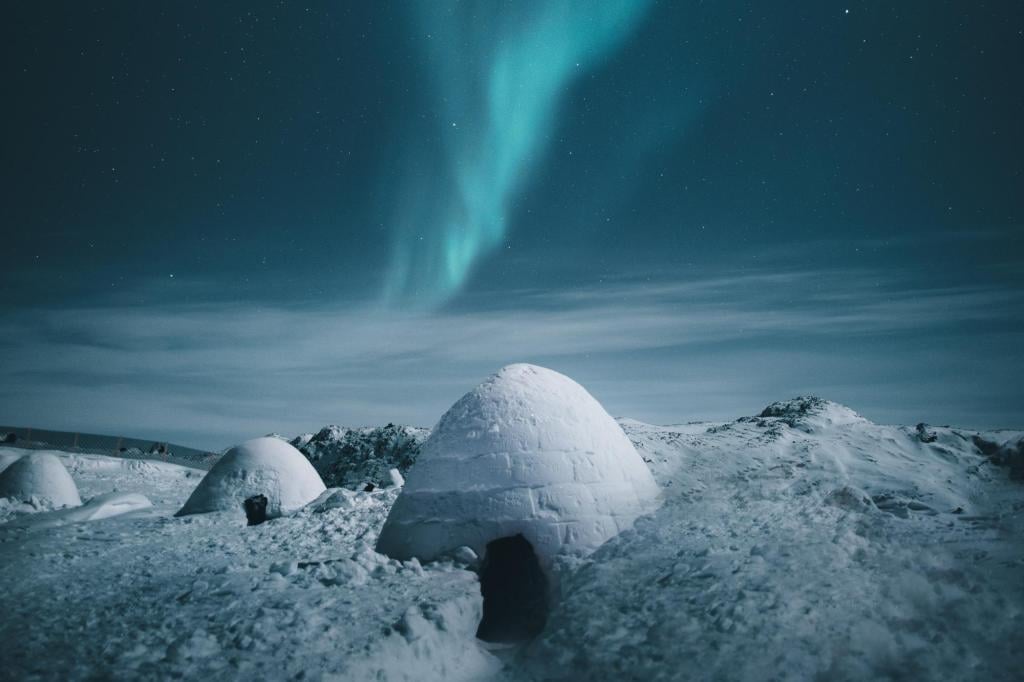

Sermermiut in Winter – Silence, Snow, and Stories

On my very first day in Greenland, I joined a winter walk to Sermermiut, a historic site at the edge of the Ilulissat Icefjord. I didn’t know yet how much this short trail would stay with me. We met in town — just our guide, a father and son, and me. A small van brought us past the last houses of Ilulissat and dropped us at the trailhead. The snow was fresh, the sky pale, and the landscape seemed to stretch without sound. Once we stepped out, everything changed. There were no cars, no chatter — just the crunch of snow under our boots and the occasional bark of distant sled dogs. The wind brushed across our faces, but in the moments it paused, the silence felt almost unreal.
The Trail to Sermermiut
The path ahead was the World Heritage Trail, a boardwalk that winds toward the Icefjord viewpoint. In summer, it’s accessible and popular — even wheelchair-friendly. But in winter, the wooden planks were buried in snow, barely visible beneath the drifts. We followed the faint tracks of earlier walkers and trusted our guide.

He paused often to share stories: of the people who once lived here, of the ways the glacier shifts through the year, and of how life and ice are deeply intertwined in Greenland. It wasn’t a long walk, but it became a thoughtful one.
Especially in winter, I was grateful to have someone leading the way — pointing out details I would’ve missed and keeping us safe in slippery spots. The path is simple enough, but the stories gave it depth.
We walked slowly. The snow made us careful, and the views made us pause. At one point, our guide stopped and asked us to listen. We stood at the edge of the fjord, facing a frozen expanse dotted with icebergs. The only sound was the wind — and for a moment, not even that.
Sermermiut and the Ilulissat Icefjord
The Icefjord before us is a UNESCO World Heritage Site, fed by the mighty Sermeq Kujalleq glacier — the most productive glacier in the Northern Hemisphere. It calves 35 to 40 cubic kilometres of ice each year, creating a constantly shifting field of icebergs, some the size of apartment buildings.
As we stood there, gazing out over the frozen fjord, I tried to imagine what it must have been like to live here thousands of years ago.
What I learned on the walk — and what stuck with me most — was that Sermermiut wasn’t just a remote viewpoint; it was once home to several Inuit cultures over more than 4,000 years. Even though there are no buildings left, the land holds memory.
In summer, archaeologists can still identify outlines of ancient dwellings. The permafrost has preserved artefacts and graves remarkably well.
I used to think it was a harsh place to live. But hearing how the area is naturally protected by low hills, with easy access to fish and seal, I started to see the wisdom in it.
I learned that the Thule Inuit settled here around 1100, and that Sermermiut remained an important settlement for centuries. By the 18th century, when missionary Paul Egede was active in the Ilulissat area, it was considered the largest Inuit settlement in Greenland — a place where traditional life and early European contact briefly overlapped.
Today, visitors follow a wooden boardwalk through the area. It’s a low-impact way to experience the site — and an important one.
Our guide pointed out signs warning people not to leave the trail. I hadn’t realised that waves caused by calving icebergs can suddenly roll in from the fjord, reaching up to 10 metres high. That detail stuck with me — and made me understand how closely nature and risk are woven together in this landscape.

Trail Difficulty
From what I experienced, the trail to Sermermiut is relatively short — and in summer, it’s considered easy. The boardwalk is dry, clearly marked, and even suitable for wheelchairs.
But winter is a different story.
The snow hides the wooden planks, and in places, it becomes slippery and uneven. I was really glad I had good boots with me.
Before the trip, I had read that you shouldn’t hike off the trail in winter, and now I fully understand why. The snow can be deceptive, and it’s easy to lose your sense of direction, especially with limited daylight.
The ice conditions can also change fast.
After walking the trail myself, I wouldn’t recommend doing it alone in winter. Having a guide made a huge difference — not just for safety, but also for understanding where we were walking and why this place matters so much.
A Visit to the Icefjord Centre
After the walk, we stepped into the Icefjord Centre, just at the trail’s entrance. The warm wooden interior and floor-to-ceiling windows created a striking contrast with the frozen world outside. It was the perfect place to thaw fingers and reflect.
The exhibitions are both scientific and personal. You learn about the glacier’s movements, about climate, and about how people have adapted to this region over thousands of years.
What struck me most, though, was how present climate change feels here. It’s not theoretical — you can almost see it happening in real time.
The speed at which the ice moves, the stories of retreating glaciers, the subtle shifts in weather and snow levels — it all felt very close.
One thing that stayed with me in particular was hearing about how the melting sea ice is affecting hunters. The frozen fjord, once a solid highway for dog sleds, is now passable for a much shorter period each winter.
I hadn’t thought about how closely people’s daily lives — and cultural traditions — are still tied to the ice.
That conversation reminded me that climate change here isn’t just a headline or a statistic. It’s personal, immediate, and visible.
Everything is presented in Greenlandic, Danish, and English — and even after a short visit, I walked away with a much deeper awareness of how fragile and interconnected everything is in this part of the world.
Visitor Info:
The Icefjord Centre has varying opening hours depending on the season, so it’s best to check the official website before visiting.
Tickets:
Adults: DKK 150
Children (7–15): DKK 100
Children under 7: Free
Facilities include a café, a small shop, public toilets, and multilingual exhibitions. More details are available at isfjordscentret.gl
Final Thoughts
Looking back, I’m really glad I didn’t do the trail on my own.
In winter, the landscape changes the experience completely. The path softens under snow, distances feel different, and the silence becomes something you don’t just hear — but notice.
In summer, I imagine it’s a place to wander at your own pace, with the midnight sun stretching time and space in a different way. But in winter, the stillness makes everything feel more deliberate.
What stayed with me most wasn’t just the view of the icefjord, but the sense of how much history and life is layered into this place — often invisible at first glance.
Whether in summer or winter, the trail pairs beautifully with a visit to the Icefjord Centre. Stepping into the warmth after the walk and seeing the stories told from another perspective helped everything settle — the perfect way to begin my time in Greenland.